
In short: when moving to Spain with a pet (dog, cat or ferret) you need a microchip, a rabies vaccine and a travel document. From the EU, the European pet passport is enough. From outside the EU you need an animal health certificate and, depending on the country, a rabies antibody test that means waiting 90 days. On arrival, the animal is entered in the registry of your autonomous community. The travel rules are new: since 22 April 2026 Delegated Regulation (EU) 2026/131 applies.
In person or by representative? The animal travels with you or with a person you authorise in writing, no more than 5 days before or after your own trip (MAPA). How registration works depends on your region: ask your vet or town hall. For the potentially dangerous dog licence the source does not say whether a representative is accepted: plan to go in person and ask at your town hall.
Before you travel: it depends on where you come from
- From another EU country: microchip, valid rabies vaccine and European pet passport with the owner, description, marking, issuing and vaccine sections filled in. Minimum age in Spain: 15 weeks; Spain does not allow younger animals in.
- From a listed third country in Implementing Regulation (EU) 2026/636: microchip, rabies vaccine and health certificate, no antibody test. The list includes, among others, Argentina, Chile, Mexico, the United States, the United Kingdom, Japan and Australia; Montenegro and Serbia were added in June 2026 (Regulation 2026/1228). Andorra, Switzerland, Gibraltar and the other annex I countries are treated like the EU: MAPA asks for the same requirements as from an EU country. You also do not have to use a travellers' point of entry (art. 15 of Regulation 2026/131).
- From a third country that is not listed: all of the above plus the rabies antibody test. Ukraine, Colombia, Venezuela, Morocco, Russia, Ecuador, Peru, Brazil and Honduras are not on the lists. The 2022 exceptions for pets from Ukraine ended on 15 March 2023 (UcraniaUrgente).
The deadlines people miss
- The rabies vaccine counts if given at 12 weeks or older and 21 days have passed since the first dose.
- Antibody test: blood is taken at least 30 days after vaccination, in an EU-approved laboratory, with a result of 0.5 IU/ml or more. The animal can only enter 90 days after the sample. So from an unlisted country the minimum age is 7 months, and MAPA estimates at least 3 to 4 months of preparation. If boosters stay up to date, the test is valid for the animal's whole life.
- The health certificate is signed by an official vet of the country of departure (or endorsed by its authority) no more than 10 days before entering the EU. It is valid for 6 months from the border check, or less if the vaccine expires earlier (arts. 18 and 19 of Delegated Regulation 2026/131).
- Maximum 5 animals per non-commercial trip, except for competitions, exhibitions or sports events.
At the border: from a third country you enter through a travellers' point of entry (list on the MAPA page) and declare the animal to the Guardia Civil or customs, who read the microchip. If the requirements are not met, the MAPA FAQ lists as consequences quarantine, return to the country of origin or, as a last resort, euthanasia, with all costs paid by the owner. A pet passport on the old model issued before 22 April 2026 is still valid (art. 31 of Regulation 2026/131).
After you arrive
- Registration: dogs, cats and ferrets carry a microchip and are entered in the Companion Animal Registry of your autonomous community (art. 51 of Law 7/2023). An animal arriving from another EU country keeps its original passport but is also registered. The registry's name and procedure vary by region: ask your vet or town hall.
- Cats: Law 7/2023 requires a microchip and neutering before 6 months of age, except breeding cats of a registered breeder (art. 26).
- Dogs, course and insurance: Law 7/2023 has been in force since 29 September 2023. Its art. 30 requires a free dog-ownership course and third-party liability insurance. But the course content and the insurance amount will be set by a regulation, and that regulation was still a draft (June 2025 draft); we found no publication in the BOE (search 2026-10-01). The Ministry of Social Rights, in its FAQ, presents it as compulsory and says some home insurance policies already include it. More detail in the card mandatory dog insurance.
- Potentially dangerous dog: these are the breeds in annex I of RD 287/2002 (for example Pit Bull Terrier, Rottweiler, Dogo Argentino or Akita Inu), their crosses and dogs with the traits in annex II. To bring one into Spain and keep it you need a municipal licence (Law 50/1999, arts. 3 and 4). Requirements: adult age, no certain convictions, physical and psychological fitness certificates, and liability insurance of at least 120.000 €. The licence lasts 5 years. After getting it, you have 15 days to enter the dog in the municipal registry. In public: muzzle and a non-extendable lead shorter than 2 metres, one dog per person. Your region and town hall may have their own rules.
Liability insurance and vet insurance are not the same. Liability insurance pays for damage your dog causes to other people or their property. Vet insurance is voluntary and covers your animal's costs (visits, surgery). Before signing, check whether the policy includes liability cover.
Documents
- Microchip (or a readable tattoo applied before 3 July 2011).
- European pet passport (from the EU) or EU-model animal health certificate (from a third country).
- Declaration of non-commercial movement (from a third country).
- Certified copy of the rabies vaccination.
- Laboratory report with the antibody test (unlisted countries only).
- Written authorisation if the animal travels with someone else.
Indicative list based on MAPA and Delegated Regulation (EU) 2026/131; it may be incomplete, check the source.
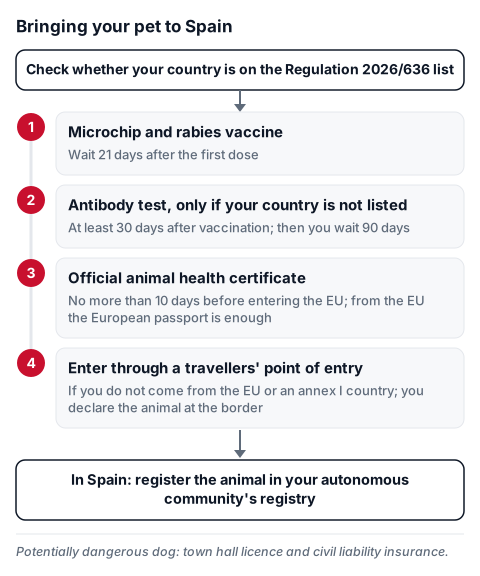
Steps:
- Check which list your country is on in Regulation 2026/636. If it is not listed, start at least 3 or 4 months ahead.
- Microchip and rabies vaccine at your vet; wait 21 days after the first dose.
- Only if your country is not listed: antibody test at an approved laboratory, at least 30 days after vaccination, then wait 90 days.
- Health certificate and declaration with the official vet, no more than 10 days before entering the EU. From the EU, check the passport.
- Enter through a travellers' point of entry and declare the animal at the border (MAPA).
- In Spain: register the animal in your region's registry; each region sets how (ask your vet or the town hall). With a potentially dangerous dog, apply for the licence at your town hall.
Official source: MAPA, travelling with dogs, cats and ferrets + Delegated Regulation (EU) 2026/131 + Law 7/2023.
Informational only; check the official source and a professional for your specific case.
