
In short: the exchange of an Ecuadorian driving licence in Spain has its own agreement between the two countries: the exchange of notes of 25 September 2003, in force since 8 September 2004. With a valid Ecuadorian licence and normal residence in Spain you can swap it for the Spanish equivalent without theory or practical tests. The exception is the C, C+E and D equivalents, which come with tests. A new equivalence table has applied since 14 September 2024.
In person or by representative? Mixed. You do the medical fitness report (informe de aptitud psicofísica) in person at a driver assessment centre (CRC). The application goes to the Jefatura Provincial de Tráfico, and the regulation says it is signed by the applicant (art. 23.1 of the General Drivers Regulation). Even so, according to the DGT page for Ecuador and other countries with prior verification, the exchange has two phases. First Ecuador is asked to confirm that your licence is valid, and only the holder can request that verification. After that, the exchange application can be filed by the holder or by anyone authorised on their behalf, online (digital certificate or Cl@ve) or in person at a Traffic Office (Jefatura u Oficina de Tráfico) with an appointment. To authorise someone, you appoint them in the DGT register of powers of attorney (procedure “Canjes de permisos extranjeros”). If they go in person, the DGT form “Otorgamiento de representación” signed by you and stating that the representation is free of charge also works; when booking, both people's ID documents are given. To finish, the original Ecuadorian licence is handed in at the Jefatura.
Before you start. What is common to all countries is on two cards: driving in Spain with a foreign licence and the 6-month limit and exchanging a foreign driving licence. The first one explains what normal residence is. This card covers only what is specific to Ecuador. If you will drive, insurance is separate: car insurance for foreigners.
What the agreement says (BOE-A-2003-20256):
- It recognises the licences each country issued to people who lived there habitually, as long as they are valid (paragraph 1).
- Until you exchange it, you can drive in Spain for the time Spanish law sets (paragraph 2). That is 6 months from when you acquire normal residence (art. 21 of the General Drivers Regulation). After those 6 months, the Ecuadorian licence is not valid for driving in Spain (art. 21.3), but the exchange can also be requested later (art. 22.1).
- You can ask for the exchange once you have acquired normal residence or have shown by document that you started the process to acquire it (paragraph 3). The Spanish regulation speaks of residence already acquired (art. 22.2). Which document counts in practice for a process already started, the text does not say: ask the DGT.
- You do not have to take the theory or practical tests needed to obtain a licence, except for the Spanish equivalents C, C+E and D (paragraph 4). For those, a test of specific knowledge about those vehicles is asked, without mechanics and oral if you request it, plus a driving test on open roads with a vehicle of that class.
- Each country's formalities still apply, such as the application form, a medical certificate, a criminal record certificate or the fee (paragraph 6).
- If there are well-founded doubts about whether your licence is genuine, Spain can ask Ecuador to check it (paragraph 5). The exchanged licence goes back to the authority that issued it (paragraph 7).
- The agreement may not apply to an Ecuadorian licence that was itself issued by exchanging one from a third country (paragraph 9).
- It runs for an indefinite period and either country can end it with 3 months' notice (paragraph 10).
What changed in 2024. The exchange of notes of 28 August and 10 September 2024 (BOE-A-2024-19676, published on 1 October 2024) replaces the equivalence table in the annex. The text gives as the reason that the Ecuadorian rules on driving licences changed, and the amendment is proposed on the DGT's initiative. It has applied provisionally since 14 September 2024. The text consulted does not give a date for definitive entry into force. Only the table is changed: the rest of the agreement, including the tests in paragraph 4, is left alone. It also says nothing about applications filed before 14 September 2024.
Your Ecuadorian class and the Spanish licence it gives, before and now:
- A: before it gave A1 and A; now it gives only A.
- A1 (new class in the table): now it gives A.
- B: before it gave B and B+E; now it gives B.
- C1 (new class in the table): now it gives B.
- C: before it gave B+E and C; now it gives D1.
- D: before it gave B+E, C and D; now it gives D.
- E: before it gave C+E and D; now it gives C+E.
- F and G: before, no equivalence; now the note says they cannot be exchanged.
The new table adds that the Ecuadorian classes C1, C, D and E also include the Spanish B. With it, no Ecuadorian class is exchanged any longer for the Spanish AM, A1, A2, B+E, C1 or C. Note 2 also says that the Spanish B matches only the Ecuadorian B and is not exchanged for the C1. The text does not explain how this fits with the marked C1 box in the B row: if your licence is C1, confirm it with the DGT. And if your class is C, the table gives D1, which paragraph 4 does not name; the text does not say whether it needs tests.
If you got the licence while already a legal resident in Spain. The DGT sums it up in its foreign-licence information (version of 28/04/2025): a licence obtained while already a legal resident in Spain cannot be exchanged; only one you obtained before becoming a resident counts. Paragraph 1 of the agreement speaks of licences issued to people whose normal residence was in the issuing country: these are different concepts and the text of the agreement does not settle this case.
Documents (annex III of the General Drivers Regulation, exchange of licences from third countries):
- DNI or NIE number, with your consent for your identity data to be checked. If you do not give it, a photocopy of the TIE (or of the student card).
- A recent photo of your face, 32 by 26 mm, in colour on a light background.
- A written statement that you are not deprived of the right to drive by a court decision.
- A written statement that you do not hold a licence of the same class from the EU or EEA, or one that is restricted, suspended or cancelled.
- A medical fitness report from an authorised driver assessment centre.
- An express statement in which you answer for the authenticity, validity and currency of your licence and, if needed, its official translation.
- The original Ecuadorian licence and a photocopy.
The DGT may ask for additional reports, including a certificate from the Ecuadorian body that issued it, endorsed by the consulate (art. 23.2). The agreement lists a criminal record certificate among possible formalities; annex III does not include it. This list may be incomplete or out of date: confirm it on the DGT page. The fee exists, but we do not copy the amount because it changes: the DGT states it.
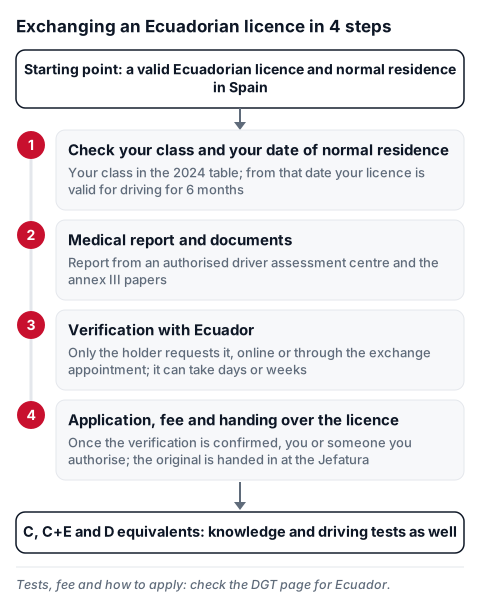
Steps:
- Check that your Ecuadorian licence is valid, which Spanish class it matches in the 2024 table and since when you have normal residence (the 6 months in which you can drive with it count from that day; you can already ask for the exchange), and that you did not obtain it while already a legal resident in Spain.
- Pass the medical fitness test at an authorised driver assessment centre and gather the other documents on the list.
- Request the verification of your licence with Ecuador: online on the DGT electronic office or, in person, through the exchange appointment, which starts it. Only the holder can request it, and according to the DGT the reply can take days or weeks.
- Once the verification is confirmed, file the application on the official form (you or someone you authorise) at the Provincial Traffic Office or online, pay the fee and hand over the original Ecuadorian licence. If you ask for a C, C+E or D equivalent (for D1 confirm with the DGT), get ready for the tests.
Official source: Spain-Ecuador exchange of notes, 2003, 2024 amendment and Royal Decree 818/2009, arts. 21 to 23.
Informational only; check the official source and a professional for your specific case.