
In short: the green NIE is the EU citizen registration certificate (EX-18 form) that citizens of the EU, the EEA and Switzerland request in Spain when they stay more than 3 months. Health insurance is only shown if you do not work in Spain; employees and the self-employed prove their work. You file in person, with a fee of 12 €, and the certificate is issued on the spot.
In person or by representative? In person: the application is filed personally at the Oficina de Extranjería of the province where you will live or, failing that, at the corresponding Comisaría de Policía (RD 240/2007, art. 7.5; Orden PRE/1490/2012, art. 2.2). It is not an online procedure. If you cannot go yourself, ask your office whether it accepts a representative.
Green NIE, NIE and TIE. «Green NIE» is the popular name of the EU citizen registration certificate (certificado de registro de ciudadano de la UE, sometimes called CUE). The NIE is only the foreigner identity number: it appears on the certificate together with your name, nationality, address and registration date (art. 7.5). The TIE is the card for non-EU foreigners. EU citizens receive the certificate, not a card. To identify yourself you keep using your passport or ID. If you only need an NIE number without residing, that is a different procedure: how to apply for the NIE. If your family member is not an EU citizen, they need the card: EU family member residence card, which asks for your certificate first.
Requirements
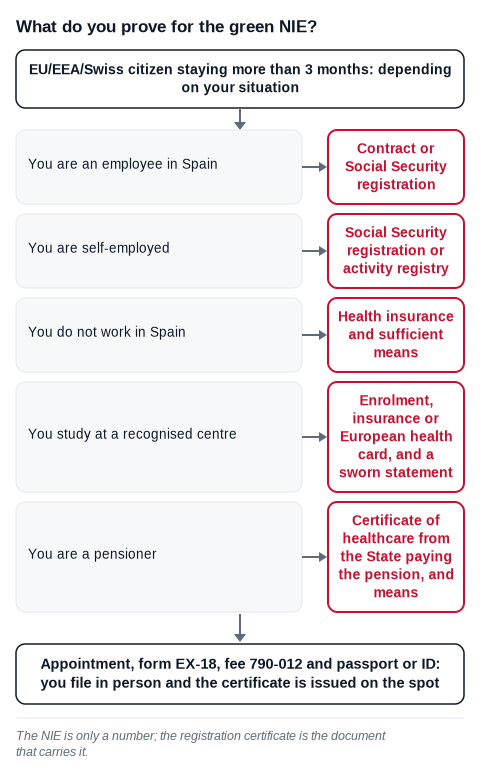
To stay more than 3 months you must fall into one of these cases (RD 240/2007, art. 7.1; evidence in Orden PRE/1490/2012, art. 3):
- You are an employee in Spain: your employer's hiring declaration, an employment certificate, a registered contract or a Social Security registration document. If you consent to the office checking it in the Social Security Treasury files, you do not need to bring it. No health insurance is requested.
- You are self-employed: registration in the Economic Activities Census, in the Commercial Registry or in the relevant Social Security scheme. If you consent to the office checking it in the files of the Social Security Treasury or the Tax Agency, you do not need to bring it. No health insurance is requested.
- You do not work: health insurance and sufficient resources for yourself and your family.
- You study: enrolment at a centre recognised or funded by the education authority, insurance (the European health card is enough if it covers the whole period of residence) and a sworn statement that you have sufficient resources. Taking part in an EU educational exchange programme (such as Erasmus) is treated as sufficient proof of these requirements.
- You are a pensioner: for pensioners, a certificate that they are entitled to healthcare at the expense of the State paying the pension is enough to meet the insurance condition; the resources are shown in the same way as for someone who does not work.
Which insurance works. If you do not work: public or private health insurance, taken out in Spain or in another country, with cover in Spain during your residence equivalent to the National Health System (Orden, art. 3.2.c); the RD speaks of covering all risks (art. 7.1). «No co-payments» and «no waiting periods» are conditions that several consulates ask for visas; they do not appear in RD 240/2007 or in the Orden. The office assesses your specific policy when you file: if in doubt (travel policy, insurance from another country), ask your Oficina or Comisaría first. More on policies in private health insurance for foreigners.
Resources. There is no fixed amount (art. 7.7). Having more than the amount the State Budget Law sets each year for entitlement to a non-contributory benefit is treated as sufficient, taking your personal and family situation into account (Orden, art. 3.2.c). You prove it by any valid means: property titles, certified cheques, capital income or a credit card with an up-to-date bank certificate of the available credit. If you work remotely for a company outside Spain, ask your office which category fits you.
Family members who are EU nationals. Each one files their own EX-18 (Orden, art. 4.4).
Family of students. If you are a student, the regime applies only to your spouse or registered partner and to dependent children (Orden, art. 4.2), whatever their nationality.
Documents
- Form EX-18 (application for registration in the Central Registry of Foreigners, EU citizen residence), from the procedure page on the Police website. The instructions on the form ask for the original and a copy.
- Proof of payment of the fee, form 790 code 012.
- A valid passport or national ID; if expired, a copy and the renewal application (art. 7.6).
- The evidence from the Requirements section that matches your situation.
- Some offices also ask for the empadronamiento certificate: confirm it when you book the appointment.
Cost
Fee, form 790 code 012: 12 € (Orden PJC/617/2025, item 4.6), the same as the Spanish ID card (RD 240/2007, art. 14.1). It is paid at banks, savings banks or credit cooperatives without needing an account, and the form is generated on the Police website. Whether it must be paid before the appointment is stated in your province's instructions.
Deadlines
- Up to 3 months in Spain, a valid passport or ID is enough; that time does not count as residence (art. 6.1).
- To stay more than 3 months, the application is filed within 3 months of entering Spain (art. 7.5). If you are already past that, you file at the same place: ask your Oficina or Comisaría how to proceed.
- The certificate is issued immediately (art. 7.5; Police procedure page).
- If something is missing, you have 10 days to complete the application; otherwise it is treated as withdrawn (Orden, art. 2.3).
- The certificate stays valid while you remain in one of the cases above; report changes of nationality, marital status or address (art. 14.2).
- After 5 years of continuous legal residence you can request the certificate of the right of permanent residence (art. 10.1), at the same office and, according to the EX-18 form itself, with that same form. Ask there about the amount and whether an appointment is needed.
Appointment and Cl@ve. You book the cita on the icpplus site, as explained in cita previa for extranjería: you choose the province and the option usually called «Policía - Certificado de registro de ciudadano de la UE» (the name changes by province). It is free: do not pay anyone for a slot. Neither Cl@ve nor an electronic certificate is required to file; you only need one if you tick the electronic notifications box on the EX-18.
Steps
- Identify your situation (you work, you do not work, you study or you are a pensioner) and gather the evidence.
- Download and fill in form EX-18, original and copy.
- Generate and pay fee 790 code 012.
- Book a cita on icpplus, for the EU citizen registration certificate.
- Within 3 months of your entry, go in person to the Oficina de Extranjería or Comisaría with your passport or ID, the EX-18, the fee receipt and the evidence.
- Receive the certificate on the spot and check that your name, nationality, address and NIE are on it.
Official source: RD 240/2007, art. 7 · Orden PRE/1490/2012 · National Police procedure page.
Informational only; check the official source and a professional for your specific case.
